Alignment length no gaps
Alignment length excluding gapped sites
Command identity
- Canonical command:
alignment_length_no_gaps- Handler:
alignment_length_no_gaps- Aliases:
aln_len_no_gaps, alng
- Standalone executables:
pk_alignment_length_no_gaps, pk_aln_len_no_gaps, pk_alng
- Categories:
Alignment quality & statistics
Runtime interface
Synopsis
phykit alignment_length_no_gaps <alignment> [--json]
Arguments
This table is generated from the live command parser. It is the authoritative source for accepted spellings, required arguments, types, defaults, and choices.
Argument |
Required |
Type |
Default |
Choices |
|---|---|---|---|---|
|
true |
str |
required |
any |
|
false |
boolean |
false |
any |
Output and errors
--json provides the command's structured JSON representation. Unless the guidance below states otherwise, results are emitted as command output. Invalid command syntax exits with status 2. Input
validation and scientific limitations are described in the guidance below.
Guidance, interpretation, and examples
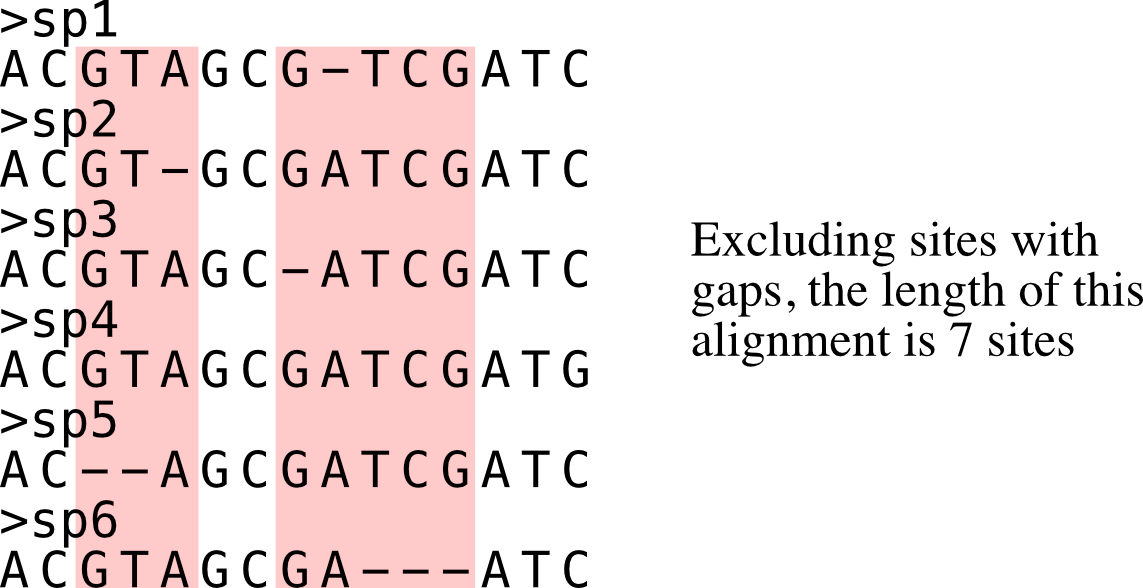
Calculate alignment length excluding sites with gaps.
Longer alignments when excluding sites with gaps are associated with a strong phylogenetic signal.
PhyKIT reports three tab delimited values: col1: number of sites without gaps col2: total number of sites col3: percentage of sites without gaps
The association between alignment length when excluding sites with gaps and phylogenetic signal was determined by Shen et al., Genome Biology and Evolution (2016), doi: 10.1093/gbe/evw179.
phykit aln_len_no_gaps <alignment> [--json]
Options:
<alignment>: first argument after function name should be an alignment file
--json: optional argument to print results as JSON